The flip side of stress
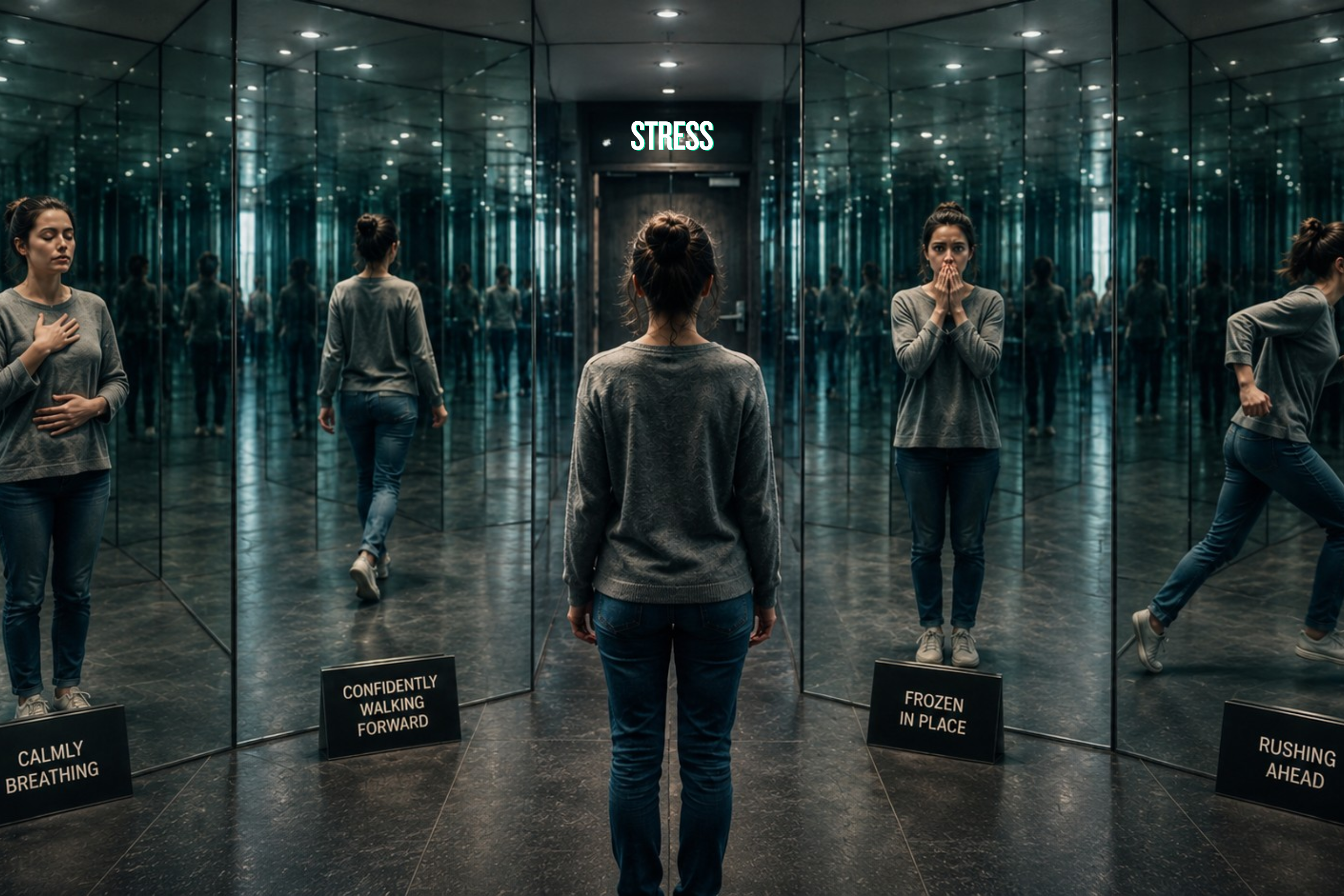
For many people, the word stress has become synonymous with danger — something to be reduced, suppressed, or escaped as efficiently as possible. Entire industries have formed around helping us “de-stress,” promising calm as the ultimate destination. Yet what if the real task is not to remove stress from our lives, but to learn how to engage with it more effectively?
Emerging psychological perspectives suggest that stress is not a binary experience — either present or absent — but something more like a range or continuum. Within this view, stress can be activating, tolerable, or overwhelming depending on its intensity and duration, as well as the internal and external resources available to us at any given moment.
Seen this way, stress is less like an intruder and more like a signal.
A deeply held assumption in modern wellness culture is that emotional equilibrium should feel calm most of the time. However, the nervous system was never designed for uninterrupted serenity. Its primary function is adaptability — the capacity to mobilize energy when needed and restore equilibrium afterward.
Mild or time-limited stressors can actually sharpen focus, enhance motivation, and temporarily increase physiological readiness through changes such as elevated heart rate and hormone release. These responses are not pathological; they are adaptive and often resolve quickly once the challenge has passed.
Problems tend to arise when stress becomes chronic, unbuffered by support, or perceived as inescapable. Under these conditions, prolonged activation of the stress response system can disrupt cognitive functioning and decision-making processes, partly through sustained exposure to cortisol and related hormones.
Avoidance, while temporarily soothing, often prevents us from developing the very capacities needed to navigate future demands.
If we shift our stance from resistance to curiosity, stress begins to reveal itself as meaningful data. It frequently indicates a demand that matters to us, a perceived gap between expectation and delivery, a threat to belonging, identity, or stability, or a situation requiring learning or adjustment.
This interpretive layer is crucial. Contemporary psychological models increasingly define stress not merely as an external event, but as a relationship between the person and their environment — one that is shaped by perceptive processes that determine whether demands are seen as manageable or overwhelming.
In other words, two individuals may encounter the same situation and experience vastly different stress responses depending on how it is internally evaluated.
Between the extremes of calm and crisis lies a range where growth is most likely to occur. This middle zone includes experiences that are effortful but not incapacitating — situations that stretch existing capacities without dismantling them.
Operating within this zone allows for skill acquisition, emotional regulation practice, greater tolerance of uncertainty, and incremental expansion of perceived competence.
Repeated movement through manageable challenges gradually recalibrates what the nervous system considers threatening. Over time, previously distressing situations may begin to feel surmountable rather than alarming.
Importantly, this is not about endurance or toughness in the conventional sense. Rather, it involves cultivating awareness of bodily sensations and emotional shifts — self awareness— that supports timely adjustment before stress escalates into dysregulation.
Strategies that aim exclusively to dampen physiological arousal can be helpful in moments of acute distress. Yet if used as the sole response, they may inadvertently reinforce the idea that activation itself is dangerous.
A more integrative approach involves recognizing early signs of activation, assessing whether the demand is meaningful or avoidable, mobilizing resources where appropriate, and allowing recovery once engagement is complete.
This oscillation between activation and restoration mirrors the natural rhythm of adaptive functioning.
Attempts to eliminate stress entirely often result in narrowed lives organized around predictability and control. Conversely, learning to navigate the stress spectrum encourages selective engagement with valued challenges, increased resilience in response to uncertainty, more nuanced emotional literacy, and expanded behavioural repertoires.
The objective is not comfort at all costs, but modulated responsiveness — the ability to meet life’s demands with sufficient energy while maintaining pathways back to equilibrium.
Stress, in this sense, becomes less an adversary to defeat and more a terrain to traverse.
And like any terrain, familiarity changes everything.
About the Author
Dr Gavril Hercz

Dr. Gavril Hercz is a nephrologist at Humber River Health and Associate Professor of Medicine, University of Toronto. He completed his psychoanalytic training at the Toronto Psychoanalytic Institute and is a member of the Canadian Psychoanalytic Society. His major area of interest is the impact of physical illness on patients, families, and caregivers.
What if the real task is not to remove stress from our lives, but to learn how to engage with it more effectively?