Emotional Turmoil in Renal Care: Time for a New Paradigm?
Over the course of my career in nephrology, one reality has remained constant: emotional turmoil is woven into every aspect of renal care. We encounter it daily—in clinics, dialysis units, transplant programs, and hospital wards. Yet despite how pervasive it is, we often struggle to understand it, name it, or respond to it meaningfully.
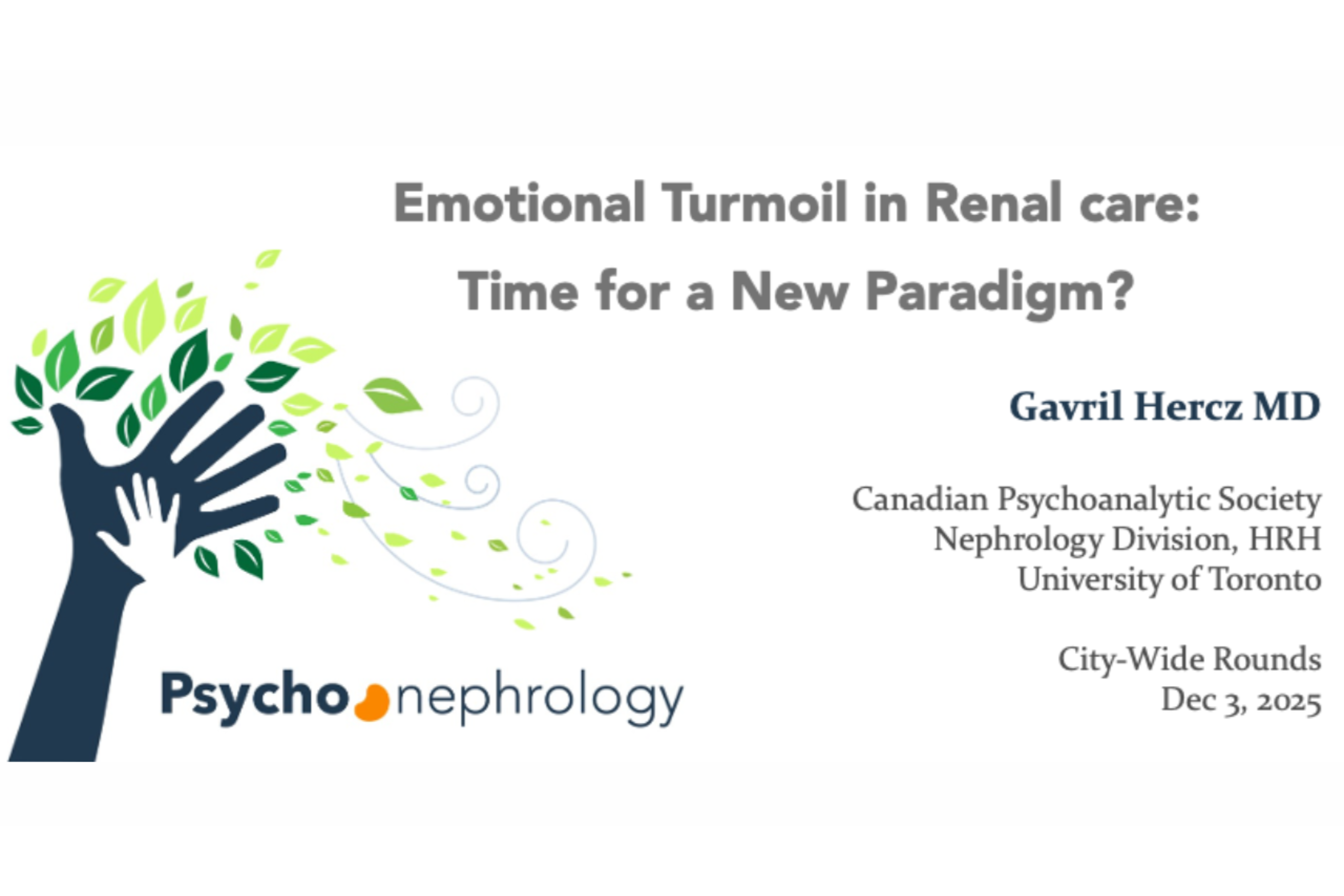
During the recent University of Toronto City-Wide Rounds, I was asked to speak about something that is difficult to quantify, difficult to measure, and therefore often marginalized in modern medicine: the emotional experience of illness. Not just for patients, but for families, caregivers, and clinicians as well.
I believe it is time for a new paradigm.
Emotional Turbulence Is Not Mental Illness
One of the most important points I would like to emphasize is this: most patients with kidney disease do not have a psychiatric illness. What they are experiencing is emotional turbulence—a normal, human response to serious medical illness.
Chronic kidney disease, dialysis initiation, transplant evaluation, graft loss—these are not simply clinical milestones. They are existential disruptions. Any one of us, placed in similar circumstances, would experience anxiety, distress, anger, grief, or despair. These reactions are not pathological. They are expected.
Yet our current healthcare model often treats emotional distress as something to diagnose and suppress rather than understand. Anxiety becomes the diagnosis rather than a symptom. Sadness becomes depression rather than a response to loss. In doing so, we risk medicalizing normal human suffering and missing its meaning.
Seeing Illness Through a Trauma Lens
I have found it far more helpful to view emotional distress in renal care through a trauma framework.
Trauma occurs when the mind is overwhelmed—when anxiety exceeds our capacity to contain it. In these moments, people feel helpless, alone, and unmoored from the story of their lives. The predictable narrative of yesterday, today, and tomorrow collapses into a relentless present filled with fear.
Many patients describe this vividly: “I can’t think ahead anymore.”
“Everything feels uncertain.”
“I don’t recognize myself.”
This loss of narrative continuity erodes resilience. It is not the severity of the medical event alone that determines the impact of trauma, but whether a person feels supported while enduring it.
The Central Role of Connection
Time and again, both clinically and in research, we see the same truth: the most powerful protective factor against trauma is human connection.
Patients who feel supported—by family, clinicians, nurses, or caregivers—experience less emotional distress. Feeling that someone is truly “with you” changes everything. It stabilizes anxiety. It restores a sense of safety. It allows meaning to emerge.
And yet, empathy and connection are difficult to measure. Because they cannot be quantified, they are often undervalued. We underestimate how profoundly therapeutic our presence can be.
Containment: What Patients Really Need
One concept I return to repeatedly is containment.
Containment means being emotionally present with someone in distress without immediately trying to fix, correct, or move past it. We do this intuitively in our personal lives. When a child is overwhelmed, we do not start with instructions. We offer comfort first. Only once the child feels safe can learning occur.
The same applies to renal care. When patients are paralyzed by anxiety—particularly during transitions such as dialysis initiation—education alone is ineffective. You cannot teach when fear dominates. First, the patient must feel contained. Only then can information be absorbed and decisions made.
This is why transition care matters. This is why timing matters. This is why emotional attunement is not optional—it is foundational.
The Body as a Messenger
When emotional distress cannot be expressed psychologically, it often emerges physically. Headaches, gastrointestinal symptoms, fatigue, pain, worsening somatic complaints—these are not coincidences. The mind and body are inseparable.
Each of us has unique pathways through which stress is expressed. Ideally, when we can talk about what we are experiencing, the tension eases. When we cannot, the body speaks for us.
This is not a weakness. It is biology.
Barriers Within Our System—and Ourselves
Why, then, is this approach so difficult to implement?
Part of the problem lies in the biomedical culture itself—one that prioritizes efficiency, diagnosis, and intervention over presence and reflection. Emotional stories are often seen as “noise” which get in the way of medical treatment.
There are also personal barriers. Many clinicians fear emotional overload, burnout, or reluctance to initiate conversations they do not have time to contain. Ironically, I believe the opposite is true. When we deny the emotional dimension of care, we carry unprocessed distress within ourselves. This, more than empathy, fuels burnout.
Acknowledging the emotional complexity of our work does not weaken us. It humanizes us.
A Call for a New Paradigm
Psychonephrology is not about replacing medical care—it is about completing it.
We cannot separate kidneys from minds, or lab values from lived experience. Patients do not leave their emotions at the clinic door. Neither do we.
If we are willing to sit with emotional turmoil rather than avoid it, we offer something profoundly healing. Not cures. Not formulas. But presence.
And sometimes, that is exactly what allows patients—and clinicians—to move forward.
You can watch the video here
About the Author
Dr Gavril Hercz

Dr. Gavril Hercz is a nephrologist at Humber River Health and Associate Professor of Medicine, University of Toronto. He completed his psychoanalytic training at the Toronto Psychoanalytic Institute and is a member of the Canadian Psychoanalytic Society. His major area of interest is the impact of physical illness on patients, families, and caregivers.
Over the course of my career in nephrology, one reality has remained constant: emotional turmoil is woven into every aspect of renal care.